New Challenges for Modern Parents
For much of the television era, children’s programming was built around a simple assumption: entertainment should also nurture curiosity. Shows were designed to capture children’s attention, but they were just as often meant to introduce ideas about science, art, history, or the natural world. Kids might not have realized they were learning, but learning was often part of the design.
Today, the environment surrounding children’s video is very different. The challenge isn’t simply that there is more content available. It’s that much of that content is now engineered primarily to maximize engagement, and the platforms delivering it are designed to keep viewers watching for as long as possible. In that environment, parents who want healthy media habits for their children have to be far more intentional than previous generations ever needed to be.
When Entertainment and Education Worked Together
Earlier children’s television often aimed to balance fun with substance. A good example appeared on Walt Disney’s Wonderful World of Color, the family television program created by Walt Disney. While the show was undeniably entertaining, it regularly explored history, science, culture, and the arts in ways that sparked curiosity in younger viewers.
One memorable segment, Donald in Mathmagic Land (1959), follows Donald Duck as he wanders through a surreal world where mathematics appears everywhere—from musical harmony and architectural design to art and sports. Rather than presenting math as a classroom subject, the film reveals it as a hidden structure underlying the world itself.
For many children, it was the first time they encountered ideas like geometric ratios or mathematical patterns in nature. Yet the film never felt like a lecture. It worked because it blended storytelling, humor, and wonder with real intellectual substance.
This balance between entertainment and curiosity was not unusual in mid-century children’s media. Even when the primary goal was amusement, creators often assumed that children’s attention should lead somewhere—toward questions, ideas, or exploration.
The Rise of Attention Engineering
In the modern digital media environment, the incentives shaping children’s content have changed dramatically. Platforms such as YouTube and TikTok distribute videos through recommendation systems that reward one thing above all else: engagement.
These systems analyze signals like watch time, viewer retention, likes and comments, and repeat viewing. The videos that perform best are the ones that keep viewers from leaving.
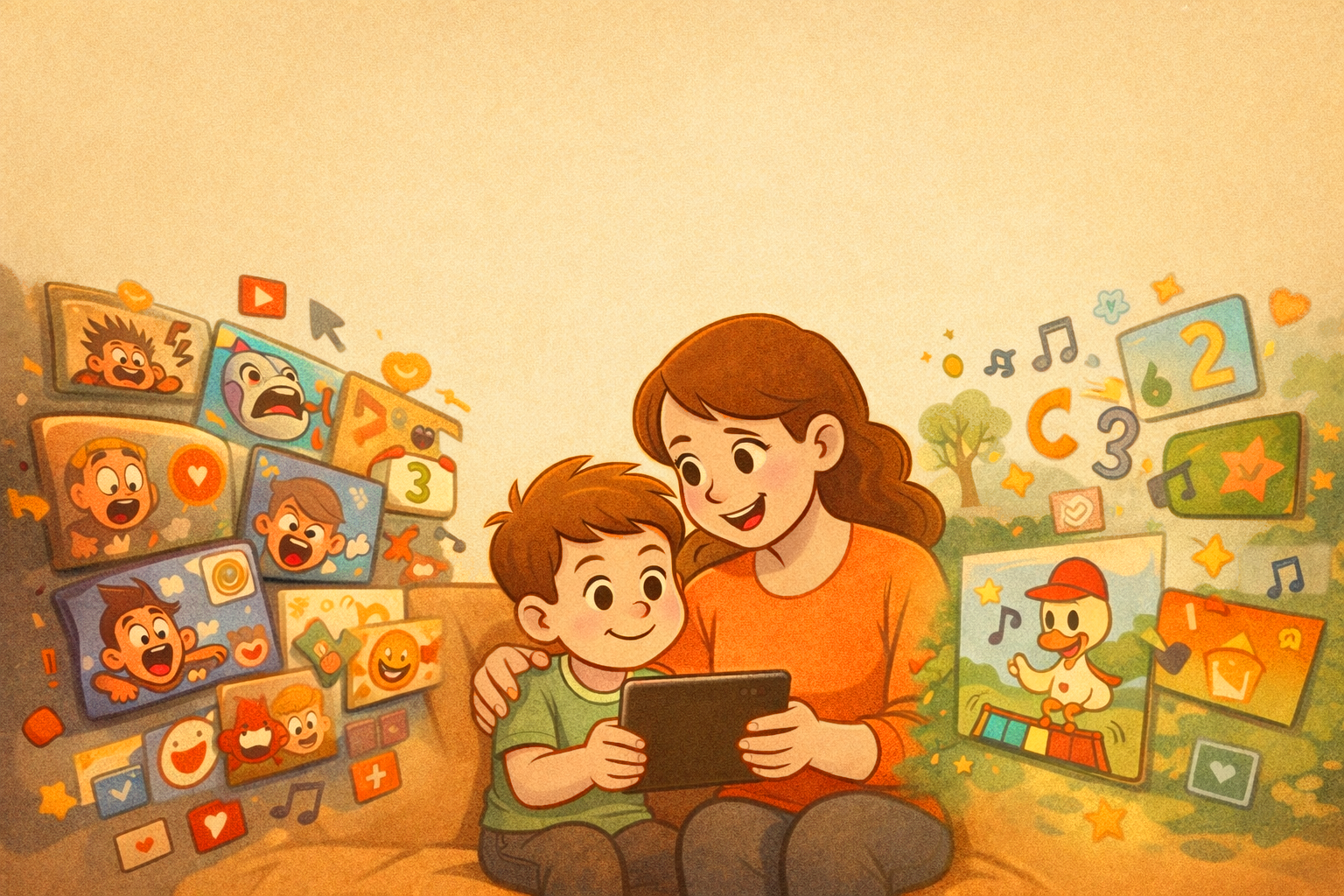
As a result, a growing share of children’s content is designed around techniques intended to capture and hold attention as efficiently as possible. These techniques often include rapid scene changes, exaggerated emotional reactions, bright colors, constant audio cues, and repetitive structures that create predictable dopamine rewards.
Many creators openly study the same behavioral design principles used in mobile games and social media feeds. The goal is not necessarily to communicate ideas or tell meaningful stories, but to maximize how long a child keeps watching.
Algorithmic Amplification
Even more powerful than the design of individual videos is the system that delivers them. Recommendation algorithms create a feedback loop: the videos that keep viewers watching the longest are promoted more heavily, which encourages creators to produce even more content optimized for retention.
Autoplay then removes natural stopping points. A child who watches one video may be automatically served dozens more without making a conscious choice to continue.
The result is a media environment where stimulation is constant, pacing is accelerated, and content quality varies widely. Instead of a single show carefully created for children, a young viewer enters a continuous stream of videos that compete for attention through novelty and intensity. This environment does not simply entertain children—it often conditions them to expect continuous stimulation.
Why Parents Must Be More Intentional Today
None of this means that modern video platforms are entirely negative. The internet contains extraordinary educational material—far more than television ever offered.
The difference is that educational content now exists alongside an enormous volume of media designed primarily for engagement, and the platforms themselves cannot reliably distinguish between the two.
That means parents must play a much more active role in shaping how video fits into their children’s lives. Where previous generations could rely on the structure of television to provide some guardrails, families today must create those guardrails themselves.
Practical Ways to Encourage Healthier Media Habits
One helpful approach is to choose content deliberately rather than relying on algorithmic feeds. Watching specific programs or curated playlists dramatically increases the likelihood that children encounter material designed to inspire curiosity rather than merely capture attention.
Turning off autoplay can also make a meaningful difference. Autoplay is one of the mechanisms that turns a single video into a long viewing session. Disabling it introduces a pause between videos and restores an element of conscious choice.
It can also help to treat video as a deliberate activity rather than background noise. Instead of allowing screens to fill idle moments throughout the day, families can treat watching a show much like reading a book or playing a game—something with a clear beginning and end.
Parents can also look for media that sparks curiosity. Programs that explore science, nature, engineering, art, or history can encourage children to ask questions and explore ideas beyond the screen. The goal is not to eliminate entertainment, but to ensure that entertainment sometimes opens doors to discovery.
Finally, watching together occasionally can transform passive consumption into a shared experience. When parents and children watch the same program, even brief conversations about what they saw can turn entertainment into an opportunity for learning.
From Passive Watching to Intentional Media
Older children’s programming was far from perfect, but it often assumed that entertainment and curiosity could coexist. A cartoon might make a child laugh, but it might also introduce them to music theory, architecture, or mathematics along the way.
Today’s media environment is far more powerful—and far more engineered. That doesn’t mean children cannot benefit from video. It simply means that healthy media habits no longer happen automatically.
They happen when parents choose content deliberately, set boundaries around consumption, and ensure that the screen sometimes does what the best children’s media has always done: not just hold attention, but spark curiosity about the world beyond it.