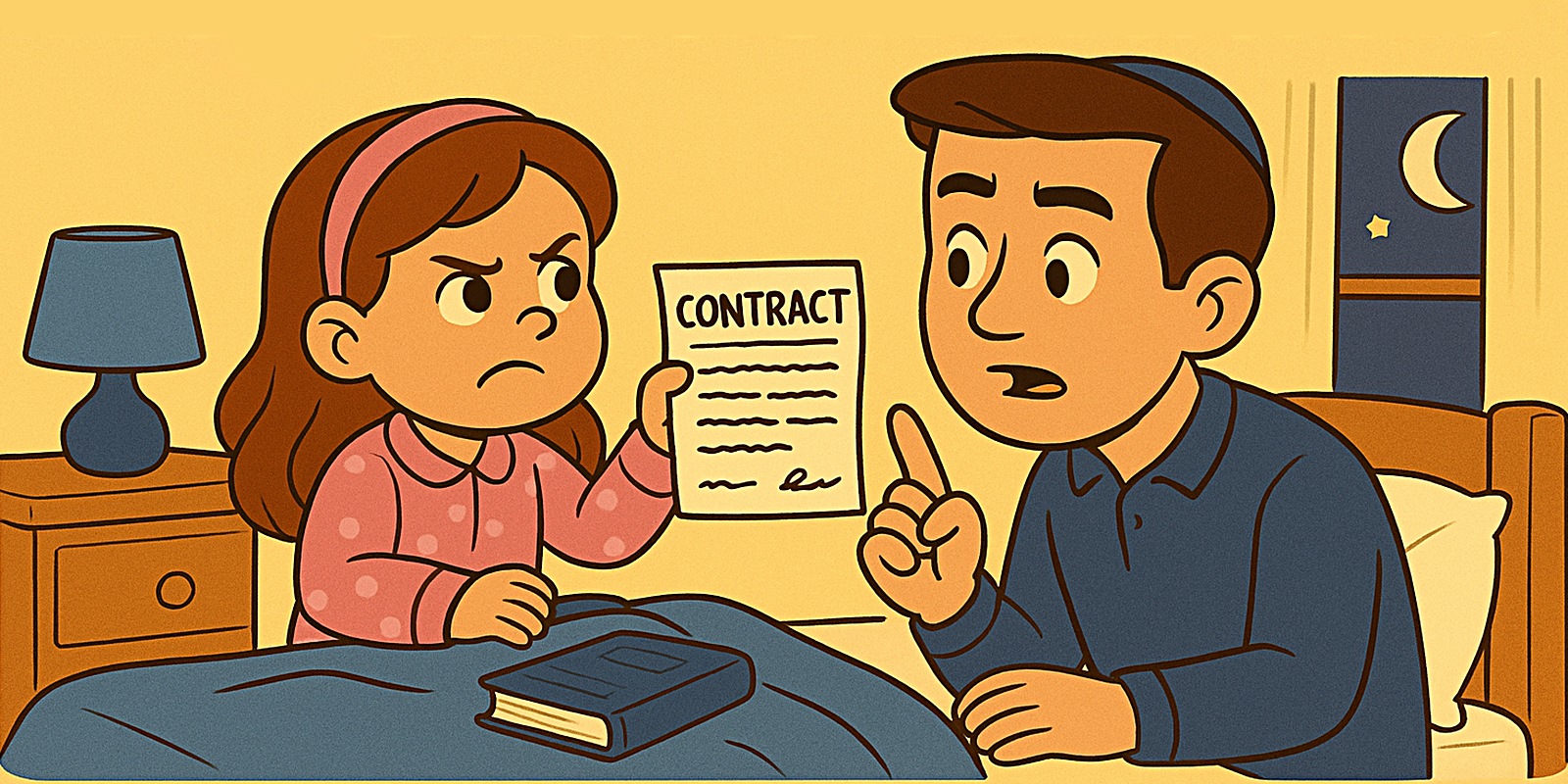
This morning, I found a crumpled piece of paper under my pillow. It was a “contract” my daughter had written the night before, complete with clauses about reading “three—not two—books,” and the agreed-upon bedtime snack. The deal, she insisted, had been signed. By me. In my sleep.
It made me laugh—but it also hit a nerve. Lately, bedtime in our house has begun to feel less like a winding-down routine and more like a negotiation table. There’s always something: she’s thirsty, forgot to brush her hair, needs to find a missing sock, or suddenly wants to discuss the moon’s orbit. And no matter how early we start, we’re still running late.
Turns out, we’re not the only family drafting late-night contracts.
Delaying Tactics Are a Developmental Rite of Passage
In a 2020 survey published in Pediatrics, over 60% of parents reported that their child “frequently or always” engages in bedtime stalling. These “curtain calls”—a term coined by sleep researchers—are consistent across cultures and age groups, particularly between ages 3 and 8.
Child psychologist Dr. Lisa Meltzer notes that these tactics are rarely about sleep itself. “For many children, bedtime is the first time all day they’re alone with their thoughts. They start to notice fears, ask questions, and look for connection.” The resistance isn’t just about avoiding sleep—it’s about maintaining engagement and control in a moment when everything quiets down.
Bedtime, then, becomes a theater of autonomy. And for kids learning how to navigate their own agency, even a small sense of control—like choosing which pajamas to wear—can spiral into a 20-minute debate about why sharks don’t sleep.
What’s Actually Happening in the Brain
Neurologically speaking, a child’s ability to self-regulate—especially in transitions—is still under construction. The prefrontal cortex, responsible for decision-making and impulse control, develops slowly through adolescence. Meanwhile, their limbic system, which drives emotions and instincts, is firing on all cylinders. Add in the melatonin delay that many kids naturally experience, and you’ve got a recipe for a nightly power struggle.
As parenting author Dr. Becky Kennedy puts it: “Children aren’t trying to win—they’re trying to feel seen and safe.” That doesn’t mean they don’t push boundaries. But it reframes the behavior as communication, not defiance.
In this light, those endless bedtime questions might not be stalling—they might be attempts to anchor themselves in a world that’s changing fast, both inside and out.
When Evening Chaos Echoes Through the Day
Left unchecked, this nightly routine can wear thin—on patience, time, and even family dynamics. Over time, late bedtimes lead to overtired kids, shorter tempers, and mornings that begin in a fog. For parents, it often feels like the day never really ends—and that mental break we long for remains just out of reach.
Culturally, this tension is nothing new. Across many traditions, bedtime is meant to be a time of peace—whether through prayer, storytelling, lullabies, or gentle rituals that mark the end of the day. But in modern family life, with overbooked schedules and glowing screens, the pace rarely slows down until it’s forced to.
Spiritually, there’s value in the pause that bedtime offers. A moment to connect, reflect, and settle—together. If it’s always a tug-of-war, we lose that chance for shared calm, which many parents (and kids) deeply need but rarely name.
What If It’s Not the Sleep, But the Script?
So what if the solution isn’t just earlier bedtimes or firmer boundaries? What if it’s a shift in how we view the moment itself—not just as a task to complete, but as a relationship to honor?
A well-designed bedtime routine could still allow children to feel some control, while gently guiding them toward rest. It could offer moments of connection without opening the door to endless loopholes. It might be less about eliminating every excuse, and more about helping kids feel ready—to let go of the day, and trust that tomorrow will come.
But how that looks will differ in every home. What matters is recognizing the pattern—and choosing to be curious about it.
Is this something you’ve experienced with your kids? Do the excuses evolve over time—or stay the same? Have you stumbled on anything that helps shift the energy at bedtime, even a little? We’d love to hear your stories. Because if bedtime feels like a chess match lately…you’re definitely not playing alone.